
Q2 Construction Market Update 2026: Record Project Values Signal Strong Future Pipeline
Construction News
The UK construction industry is entering a period of significant change. According to the latest Glenigan Construction Industry Forecast 2026-2027, the sector is set for a steady upswing after a challenging 2025. With major construction industry jobs in the UK specifically in private housing, industrial/logistics, offices, civil engineering, education and health, but employees and construction job seekers must stay ahead of the curve to remain competitive.
For employers, this growth brings a familiar challenge: skills shortages, increased competition for specialist talent, and the need for strategic recruitment to meet upcoming demand.
At Atkins Search, we support construction, consultancy, and built environment businesses across the UK to attract, hire and retain the right professionals to deliver projects on time and within budget. Below, we break down what the latest forecast means for your organisation and how to stay ahead of the competition.
The 2026-2027 period is forecast to be shaped by:
While 2025 saw declines in several areas, particularly in the private housing, education and health sectors, the market is expected to rebound strongly from mid-2026 onwards as government programmes stabilise and investment flows back into capital projects.
With this anticipated growth comes heightened demand for site managers, project managers, design engineers, quantity surveyors, pre-construction professionals, construction planners, Health & Safety specialists, and wider project delivery teams. Ultimately, a surge in construction industry jobs in the UK means partnering with specialist construction recruitment agencies is becoming increasingly important.
If you want to ensure you’re securing the best people in a competitive market, partner with a specialist construction recruitment consultancy early.
Contact Atkins Search today.
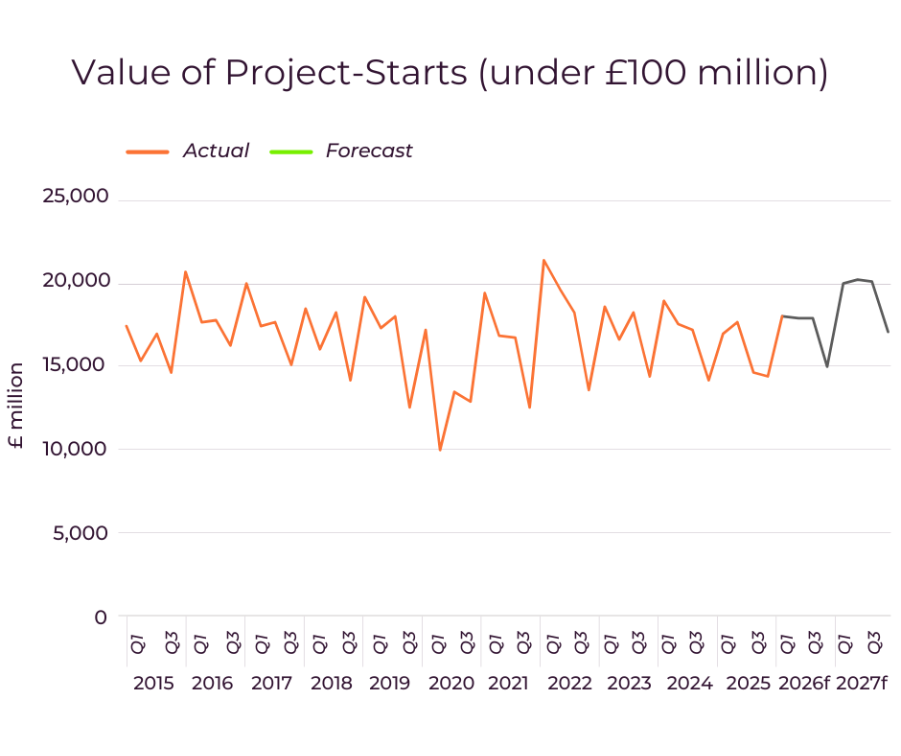
Below is a construction employer-centric summary of the key sectors covered within the Glenigan Forecast.
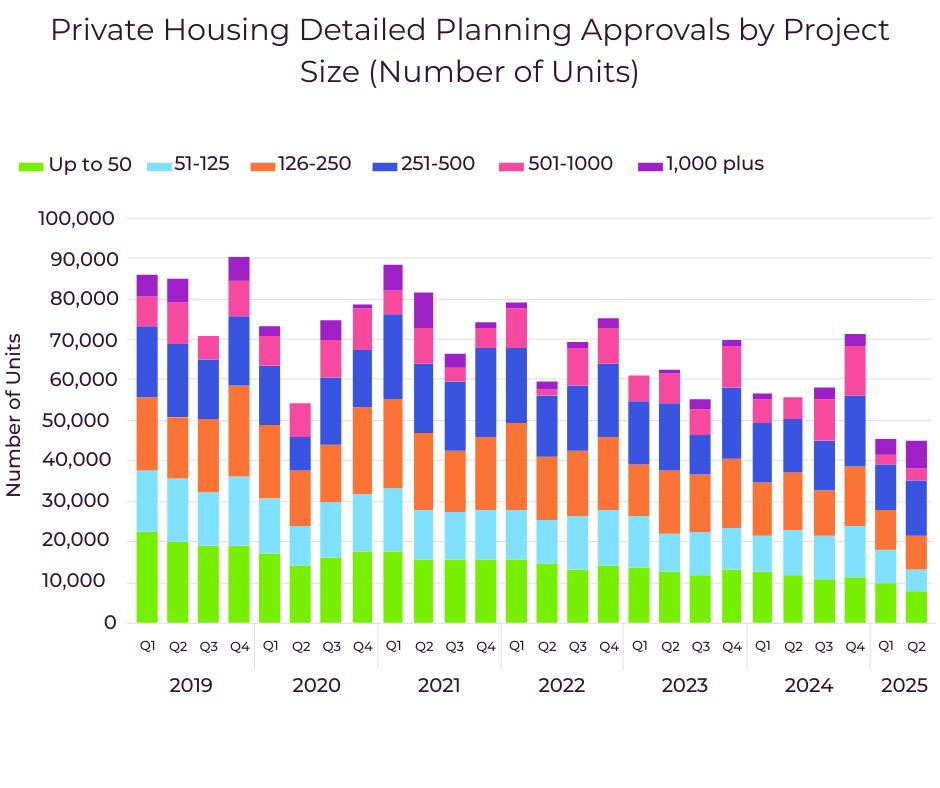
Following a drop in 2025 due to stamp duty changes and regulatory delays, private housing is expected to accelerate from 2026. Inflation has picked up this year, delaying the decline in interest rates. There is also growing uncertainty ahead of the Autumn Budget which is deterring both potential house buyers and developers from opening new sites.
Skills in highest demand will include:
Developers should prepare for talent shortages, particularly as BSR approval backlogs reduce.
Secure future talent pipelines now with Atkins Search.
Wage growth is still outpacing inflation, and both inflation and interest rates are expected to ease over the next year. Rising household incomes and lower borrowing costs should boost buyer confidence and housing market activity in 2026-2027.
Supply constraints are also set to improve as the BSR clears approval backlogs, while planning reforms are expected to release more development land, supporting sector growth later in the forecast period.
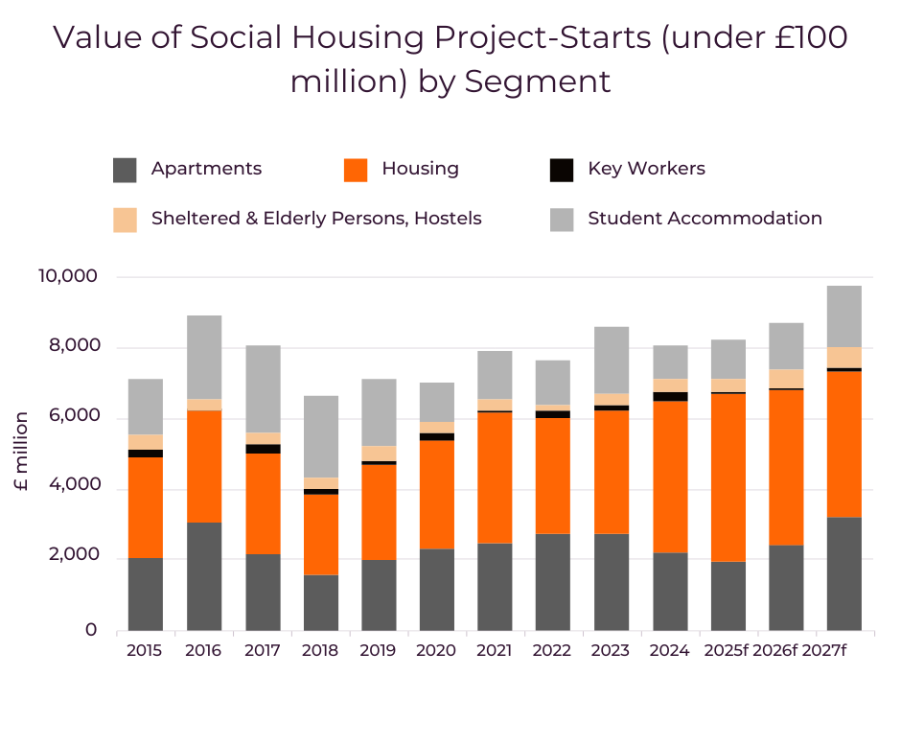
Despite a temporary setback around the third quarter, social housing saw a generally positive trend this year. Low-rise developments constituted the largest share of housing association development, whilst apartments will continue to decline, reflecting the added cost and delays following the Building Safety Act. A recovery in student accommodation starts is also underway after halving in activity during 2024, despite tighter visa rules reducing the number of international students.
Key hiring needs:
Social housing project starts are set to rise over the next two years, supported by Government commitments to 1.5 million homes, increased Spending Review funding and greater access to private finance. This will strengthen housing associations’ development pipelines through 2026 and 2027. The sector will also benefit from growing student accommodation activity as developers respond to reduced buy-to-let investor demand.
UK manufacturers have faced heightened geopolitical instability, with US tariffs and other measures encouraging the relocation of manufacturing capacity. Following a weakening development pipeline in 2024, manufacturing project starts fell sharply by 6%, limiting sector activity in 2025.
Roles expected to surge:
Against this background, industrial project starts are expected to slip back by 3% this year, with modest growth of around 4% per annum anticipated during 2026 and 2027
Sector growth over the next two years will be supported by a recovery in manufacturing projects and ongoing expansion in warehousing, driven by rising demand from online retailing for logistics and light industrial space. The updated National Planning Policy Framework will also boost activity by requiring local authorities to identify strategic sites for inward investment, including gigafactories, freight hubs and logistics centres.
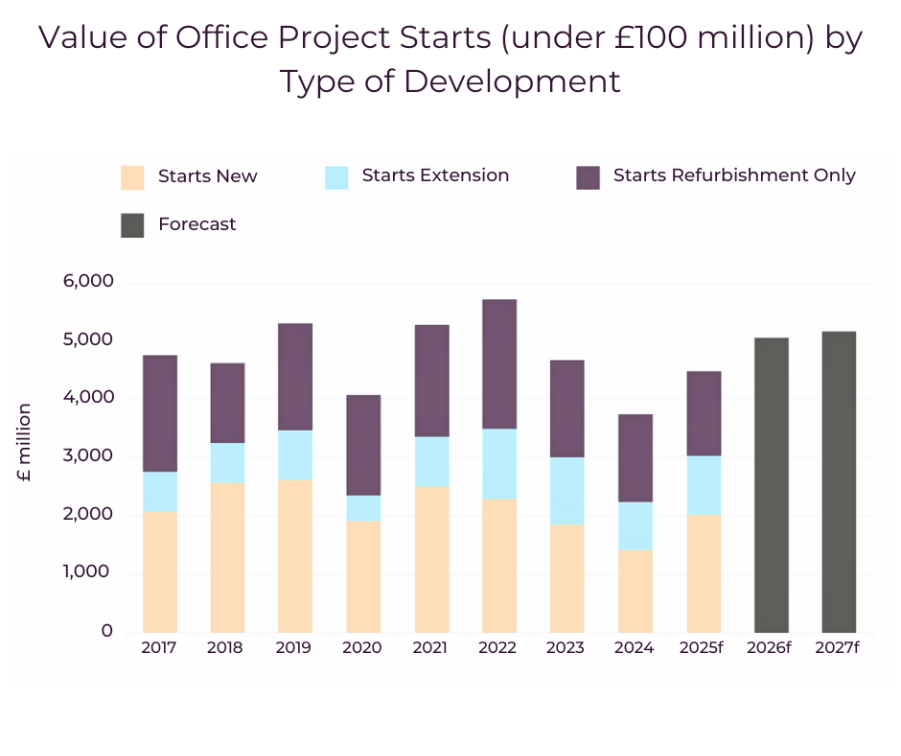
Hybrid working has changed requirements but not reduced demand, meaning the office sector returned to growth in 2025. The UK saw lower borrowing costs, renewing investor confidence, supporting a rise in refurbishments, upgrades, and sustainable new builds.
Growing talent needs:
Hybrid working continues to reshape the office market, with office take-up in Q2 2025 reaching a three-year high and boosting demand for both new build and refurbishment projects. Despite a slowdown in new planning approvals, a strong backlog of previously approved schemes is expected to drive growth, with project starts forecast to rise 13% in 2026 and 2% in 2027.
Data centres are also set to expand, supported by government efforts to attract AI investment, including a £30 billion Tech Prosperity Deal to develop an AI growth zone in the North East.
Road and rail projects were delayed by the post-election review of government programmes. This has prompted a reduction in infrastructure project starts this year, despite the government providing near-term funding for smaller scale projects such as road repairs. Utilities projects also slipped back due to a temporary dip in renewable generation project start.
Sectors requiring significant recruitment:
Hard-to-fill roles:
Speak to Atkins Search about building long-term infrastructure teams!
With Ofwat’s £104bn water investment package, grid upgrades, renewables, roads and rail all high on the agenda, infrastructure will be one of the UK’s strongest employment areas. Growth will also be supported by major energy schemes, including Sizewell C, Hinkley Point C and the Dogger Bank Wind Farm, alongside government plans to double clean energy investment. Wider infrastructure activity is set to rise too, with £24 billion allocated for roads and major rail schemes such as HS2 and the TransPennine Route Upgrade continuing to support the sector.
6. Retail: Abundance of vacant premises deters sector growth
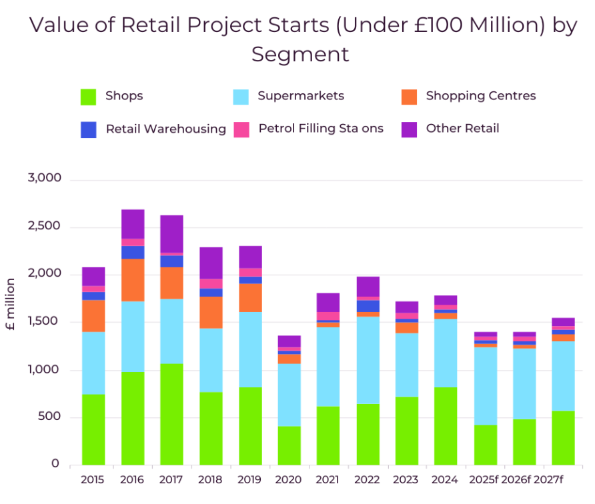
Retailers are facing rising cost pressures from higher National Insurance and minimum wage increases, squeezing margins and limiting investment in new or refurbished premises. Competition from online retail and an oversupply of vacant units are also holding back development. Persistently high inflation has delayed interest rate cuts, increasing financing costs, while the development pipeline has weakened, with planning approvals down 28% in Q3 2025 compared with the previous year.
Sectors requiring significant recruitment:
Hard-to-fill roles:
Recovery in the retail sector is expected to be gradual. Ongoing cost pressures and an oversupply of vacant units mean retail project starts are likely to stay flat through 2026. Supermarkets remain a strong performer, with discount chains such as Aldi and Lidl continuing to expand. A 10% rise in retail project starts is forecast for 2027, supported by business rate reforms and permanently reduced tax rates for high street retail, hospitality, and leisure properties, encouraging renewed investment.
While the Chancellor announced increased capital funding for the NHS in 2025/26, many additional resources have been directed toward non-construction areas. Furthermore, the post-election review of NHS priorities disrupted the development pipeline. While the Government has now published its NHS strategy, the prior uncertainty has dampened activity, contributing to an estimated 24% decline in project starts in 2025.
Sectors requiring significant recruitment:
Hard-to-fill roles:
The Spending Review and NHS plan signal increased capital funding from next April, enabling trusts to tackle the repair backlog. Project starts are forecast to rise 4% in 2026 and 15% in 2027, supported by initiatives such as the New Hospital Programme.
With skills shortages affecting every corner of construction industry jobs in the UK and entire built environment sector, organisations are competing extremely hard for the same talent. Additionally, candidates seeking construction industry jobs in the UK must continually develop their skills to remain competitive.
Atkins Search supports employers through:
Specialist sector expertise
Proactive talent pipelines
Search-led recruitment campaigns
Geo-targeted insight across the UK
Flexible recruitment models
Ready to strengthen your hiring strategy? Contact Atkins Search for expert recruitment support and remain competitive in the construction industry job UK market.
FAQs: Construction Industry Jobs & UK Forecast 2026-2027

